


I often wonder how they would react, my old teachers, to my Batchelor of Education with Honors degree, or my Post Graduate level 7 Certificate, my level 5 specialist teacher for maths, I did not make a pig’s ear of that one did I Mrs Smith? I say this or rather shout it out loud and hard in my head. I shout it out not to gloat, but to make the point that academic work can be completely achievable if presented in the right way. A child can achieve if praised and encouraged, not though if they are shot down in flames and shouted at each and every opportunity despite them putting in effort and work.
If a learner has the chance to work at their own pace, to learn and relearn, visit the topic one, twice, as many times as necessary, with the use of multisensory resources, encouragement, kind words and praise, well, there’s the chance for achievement, right there.
We know and have discussed that it is really is not rocket science, it is really not hard to put into practice many supportive strategies and to take away areas of classroom and school life that present great challenge.
These great challenges give cause for anxiety and place a child with dyslexia in a venerable position when it comes to their mental health. For failure is not only an enormous playground for poor mental health but it also surely has the perfect conditions in which to grow and spread these negative feelings. These feelings are of doubt, uncertainty, lack of confidence and of dwindling self-esteem.
Seeds are sewn in other areas of life too, even outside school where things were once a safe haven.
The result of all this is a child, teenager and young person with feelings of being completely overwhelmed. I did self-harm on more than one occasion, no-one knew, until now.
The fact I could not retain information from the board and write in in my book was never understood; to be fair this was not completely understood by me either. But no one suggested any supportive strategies. No one thought let’s change the colour of the paper, of course the backboards were just that, black, with stark white chalk that shone out too viciously and violently for me to fully comprehend and take in. Teachers can be a little like doctors if their handwriting is anything to go by, making the reading of any information even harder. In addition to this, the dusty chalk would smudge and merge making even any teachers neat handwriting very difficult to read.
I was at the mercy of the neatness of the teachers handwriting…cue Mr Stanford, what is your blackboard writing like hey? I don’t even want to call him sir, never did so I am not starting now, I can barely even refer to him as a Mr.
We know now that children with dyslexia sometimes also struggle with visual difficulties and see words and numbers far better on a different coloured background to white. Visual difficulties can be extremely hard for children when learning to read.
So many things can happen to the text and paper, seeing letters and words move, seeing large bright space around letters and words, lines, shadows, waves appearing in the text, etc, etc. How then is a young child able to access text in a coherent manner and retain and understand any of what they are trying to read?
It is important to say at this stage that any assessment for the use of a coloured overlay must be carried out by a suitable qualified professional. If there are further visual difficulties then a specialist optician needs to be involved.
Having said that, I could always read, I was good reader when reading aloud. However, when I read silently to myself, I have little idea of what I have just read. I need to re-read every time more than once, twice, three times in order to take in what the words actually said, never mind what they mean.
As a result, I am not a reader, I don’t know the meaning of the phrase, ‘reading for pleasure’ as pleasure is far removed from any form of reading for me. I know what works for me and I will often change the background colour to a pale aqua blue if I can as this helps me access the print. There are of course many applications now to aid reading from a screen which as a child growing up in the 60’s and 70’s, I would have warmly welcomed.
I did actually and very bravely I felt, attempt to help myself to improve in areas of my English work. I started with one area, spelling. Yes, it is a huge area but it was a starting point. My mum got me a small blue paperback book with the embarrassing title of First Aid in English.
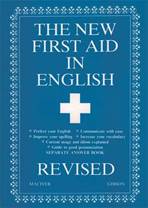
First published in the 1930’s (can you believe that it is actually still available?) I only hope that any child that feels daring and confident enough to brave taking one of these bad boys into an English classroom has a better reaction from the teacher than I did.
Mr Aldis was the teacher, George was I believe, his first name. I cannot address his first name as a Christian name as surly no one with the slightest ounce of compassion, of which Christianity is deeply rooted, would react the way he did on seeing me with my book. I was upstairs in the English classroom, getting out my stuff which consisted of a pencil case, that’s all. No drink, no fidget toy, or concentration aid, not even a little bit of Blu Tack with which to manipulate and tease, so helping to calm my nerves.
How naive am I that I thought my ‘First Aid in English’ book would be met with a positive response? Mr Aldis gave us some time at the end of the lesson to catch up, or do private study, I cannot remember the reason why we seemingly had a short time of choice, maybe we were doing mock exams or actual exams, it does not matter. What matters is that Mr Aldis walked over to my table to see what I was doing, he asked me to close the book so he could see what it was I was working on.
He took one look and began to laugh, he laughed aloud right there in front of me, in front of the whole class, he laughed! Through his laughter he managed to add yet more insult, “Do you not think it’s a bit late for that?” Yes, he actually said it… well that was me done for the rest of the day. What was the actual point of even attempting to better myself, completely on my own, individually with no help from teachers. (help and teachers did not belong together in a sentence if they had any chance to be a positive affirmation). A heads up…you won’t find that sentence in this section of the book.
The English literature curriculum has seemingly changed little since I was subjected to it in the late 1970’s, early 1980’s. We had to read Of Mice and Men written by John Steinbeck. It was pretty dreadful, depressing sometimes traumatic reading. I was wondering why I remembered it. I think it is due to now teaching it with some of my pupils in year 9, so when aged 13 or 14 years old. I also remember An Inspector Calls, again the reason why, is that I teach it with my year 10 and 11 pupils, so those 15 and 16 years of age.
I also remember going a long way on a coach to see a theatre production of the play. I do very much like this play and I feel the reason is just that, it is a play. It is all talk, all dialogue between characters and in J. B Priestley case, very well written characters. So, I can cope with following dialogue. However, what I cannot cope with is following narrative. I just do not do it. If I am needing to read something for work, preparing for a lesson I actually need to force myself to read the narrative parts. Of course, there may well be something of great importance to the whole piece of writing and if missed, I am surely only getting half of the story.
But that is what I do if I can get away with it. I skip narrative and focus on dialogue between characters. That is why I always enjoyed drama and reading plays, do not forget about the Archers! When listening to BBC Radio 4 Extra I switch channels if a book is being read.
This is where children with dyslexia can fall down in reading comprehension tasks. They are omitting single words or lines and therefore omitting text that may be needed in order to answer a question. Another difficulty in reading comprehension is inference. The ability to infer, to read between the lines is much needed and one is disadvantaged if this area is weak or completely lost in the reading exercise. I feel children with dyslexia may well skim and omit words, even if they do not mean to do so. Often, they are completely unaware they have omitted any words. This may have been done, like in my own case, in order to get to dialogue which is far richer and far more interesting and will hold attention so much better.
So, reading at the best of times was not easy for me. Long gone were the picture books of my primary school days. Long gone were the Through The Rainbow series of books when one could rise to dizzy hights of hard back covers in silver and gold. Long gone were the lovely ladybird books. Looking back at pictures of these books recently, I actually remember some of the front covers; but of course, the content is completely forgotten.
With reading, writing and spelling being a constant source of pain and failure, I felt very unhappy at this school. With so many real feelings and all this completely negative and damaging abuse being hurled my way from teachers throughout this God forsaken place it is no surprise at all that I got into trouble, and plenty of it.
Cross country was part of the PE curriculum and I actually wanted to do it. I actually wanted to run along rough paths, through a field and golf course and back to meet the original track. But sadly, despite my enthusiasm I saw an opportunity to play up, to play to the crowd, to impress those that I was threatened by day in and day out and to just plain draw attention to myself.
One, I think Wednesday morning, I set off with the rest of the class. However, when we got to the rough track, there was on the righthand side of the track, a small and somewhat dilapidated rusty, old, corrugated iron shed. It was almost standing, well making an effort to stay erect. On this particular morning, I thought I would hang back and do a slow jog, until level with the iron structure offering me my way out; I would just sneak behind it and wait.
I could easily just stay there and wait for the rest of the class to complete their running course and join them later. So that is what I did. It did work in as much as the teacher had no clue that I had ever been missing, as once back in the changing rooms all her pupils were there.
However, it only though had an impact on a couple of children so it was a fairly futile exercise, no pun intended. Just for the record, it is now a good time to add that I did actually complete the great Couch to Five K running programme, even ending up doing 6 k one day, during the corona virus pandemic lockdown. Of course, at the beginning of the running programme my mind certainly flashed back to the days of my school cross country running attempts.