
GOT A DEGREE, ME
It wasn’t till uni,
yes,
I made it you see,
got a degree and post grad,
me!
With no thanks to those
who taught me so wrong,
who just couldn’t see the way,
I needed to learn back then in the day.
Maybe they just didn’t know,
what on earth to do,
all they saw was a difficult child,
one who was hard to teach.
Trouble is though,
they just never bothered
trying to even reach
out
to the spark that all children possess,
the embers that just need to glow,
one teacher can do it,
blow gently and see
those embers burn and grow.
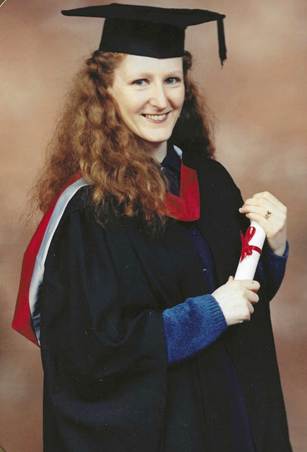
My hair is long and free flowing in my graduation photograph. It is interesting to wonder therefore if I have finally found some happiness in my education? I do not have not ribbons, bows, slides or grips in my hair but I do have a mortar board on my head so I will take that thank you. If it were down to the looks of my hair, then I am inclined to say yes. Previous photographs of me during school years and reference to my hair even in my very early years are also evidence of this. I say to my hairdresser that ‘having a good hairdresser is as important as a good doctor, I actually love my hairdresser!’
When teaching reception children in a small village primary school, I had been in post a few years before the Foundation Stage curriculum came in. It was like a breath of fresh air. Reception has been good, plenty of opportunities for learning through play. But the Foundation Stage guidance somehow made it ok to continue with this policy. I loved teaching this age group it has long been my preferred age. But I have gone on to so enjoy other age groups and include in this, my older children in year 10 and 11 studying for their GCSE’s at the ages of 15 and 16 years of age.
I so loved teaching my reception and foundation age children using a thematic approach and planning around the areas of learning all around a central theme. I would include my 4 and 5 years olds in the planning stage, giving them some ownership of their own learning even before the new theme began.
A great and very positive turning point for me was when the head teacher of one school I worked at approached me. They had family experience of dyslexia and wanted me as the Special Educational Needs co-ordinator S.E.N.co, (now called a S.E.N.D co to rightly include Disability) to deliver new training on dyslexia that had come out of the department for education.
I did so along with the SENco from the parent school, another small school in the area. This was a bit of a turning point in my career as I felt I was able to train others and give my own insight and experience along the way. Surely some of the best training comes from those who have experienced first-hand, the subject matter of the training. I have carried out and adapted bespoke training to other schools and would like to do more of this and also take training into the workplace. Many jobs are not introduced to the fact they will have some employees with dyslexia. It is important to raise awareness in these areas of work and for employees to see how their workforce can be even better supported.
After many happy years teaching in primary schools, (no-one knowing of my dyslexia) my final contract which was unfortunately temporary, ended and I left the teaching profession as I knew it over ten years ago. My new role which took off quickly, sees me teaching as a private teacher, those children who have been diagnosed as dyslexic or those that just need a little help and boost with their English.
Interesting now though, I also teach those with autism, those with Attention Deficit Hyperactivity Disorder (ADHD). I love my role as I feel I can make a difference on an individual level. I am able to offer, differentiated work to really meet the needs of my pupils. I encourage; I build up confidence and self-esteem with children who have not been able to access education in the normal everyday classroom.
I try to focus on multi-sensory teaching by using a range of appropriate resources and strategies. These resources and strategies are aimed at stimulating and fulfilling sensory need in children. Being physical, being able to move around in a classroom learning situation is so important. It is important as it helps children, young people and adults to remember what they are learning. I let children get up and walk around, I let them doodle on the table or a coloured write on wire off board, I let them use concentration aids to help their focus.
I also feel I support parents too as they try to navigate the sometimes very challenging and slow world of dyslexia and the SEND system as a whole. It can be very difficult for parents who are often juggling so much in their lives already despite trying to get the very best situation for their own child. So, to be able to offer some small support in this way is also very rewarding.
All this said, I never use to tell any of my pupils about my dyslexia. By the time I had left teaching in schools, around a handful of people knew and I wish the majority of those did not! I have been for so very long, completely guarded about my own dyslexia although celebrating the achievement of many others. I share the names of celebrities that are dyslexic and very successful but also make the point that many people, teachers, doctors and other everyday people are dyslexic and carry on with very happy and very fulfilled lives.
I do love to write and as a child and teenager I wrote a diary most nights. Recounting the day, what I had been up to, what music I was listening to, as music was always and continues to be such a very great source of comfort and expression.
I feel that for me, a world without music would be a very drab and sad world indeed. It would be a world in which I could not express myself, or lose myself, or comfort myself. It would be a world in which I kept much of my feelings tied up inside.
That is not healthy as things tied up inside are liable to knot and become very difficult to even attempt to undo. Some knots are just too tight, some strings just too long. However, I really did not know that what I was feeling or what I was experiencing in school was so wrong, it was just what happened and that was just how was, for me anyway.
I find poetry a very accessible genre for me in which I can quite easily express my thoughts and feelings. I do not read it but I write it. It was once described to me as being very cathartic, once I had looked up the meaning of the word cathartic, I was able to agree! I have always written poetry, poetry of all sorts. Poems for family members, mainly my dad. Poems in greetings cards or poems created and decorated in frames as actual presents. I have written religious poetry, funny poetry, thoughtful poetry and deep and darker poetry.
I eventually gathered my poems and added to them getting a good collection together. I got them self-published, my own book of poetry called ‘Parent days’ poems of parenthood.
I ended up on my local radio station BBC Radio Leicester, to talk about my book. It was shared briefly and in a positive light but the session took a distinctly unexpected turn. I am not actually sure how, or at the time even, why but I told them I was dyslexic!
The rest of the conversation from then on very much revolved around that fact and I did not actually read one poem on my first appearance on the show. I am hoping that will have changed by this book is out in print, if indeed it makes it that far. Who knows I may go back on the show and discuss this book.
That in itself is such an accomplishment, the publishing of a book. So, had I fulfilled myself, had I finally arrived? Yet even with that, fairly amazing feat, I feel I am not accomplished. For if one is accomplished is that not the end, or would there be the need to continue? This book, this book is the one I have wanted to write for many many years.
I am now in a much better place of acceptance about my own dyslexia, and at nearly the age of 60 years old, I think I finally feel comfortable in my own dyslexic skin. So, what a journey, so many difficulties, so many obstacles, so many people not believing in me. Many people have been far, far too quick to make a judgement, too quick to chastise and scorn, too quick to mock, to make fun off, to laugh at. Laughing at someone is simply the worst it gets and those experiences are the ones that still hurt the most. Please, please never laugh at a child!
Laughter
Laughter is great, laughter is fun,
can be healing, happiness can flow.
But whatever you do,
never, no never
laugh at a child making errors.
So very damaging,
it cuts so deep,
the sound staying with you for years.
For the very people, there to support
and nourish, to teach and develop,
simply must never, not ever smirk.
You may not see it at the time,
Your intention may not be to hurt
But just think before any reaction,
just stop and give it some thought,
just think of the effect you may have
the pain,
the detrimental hurt.
In one sense I am sorry. I am sorry that the majority of those people who taught me, well, made feeble attempts to keep me quiet; will never see this book. They will never read these words, lines and pages and never begin to question their own actions. They may never feel any slight hint of remorse or attempt to gain any sort of forgiveness. I guess many of them will long be gone, though some may still be around.
Forgiveness, well that would be expecting too much. I really feel unsure if I could ever forgive, I certainly cannot forget. I am sure, as when they had to put up with me in their class, dyslexia was not a thing, no one knew anything about it. But we do now, we do now. We know the theories behind dyslexia, we know different types of dyslexia, different acquisitions of dyslexia and we know so very much more of how to teach a child with dyslexia. So why are we not doing it so much better? Why is it estimated that 30% of those serving prison sentences in the United Kingdom are dyslexic? Something is very wrong that these people are not being picked up in schools and screened for and then diagnosed with dyslexia and beer supported. Surely then there is a chance for change or these people, for a different outcome to their lives, for them to feel that there is another way other than crime. It really is time for change.